


FlexGap – Industrial demonstration of novel adaptive flat bearing
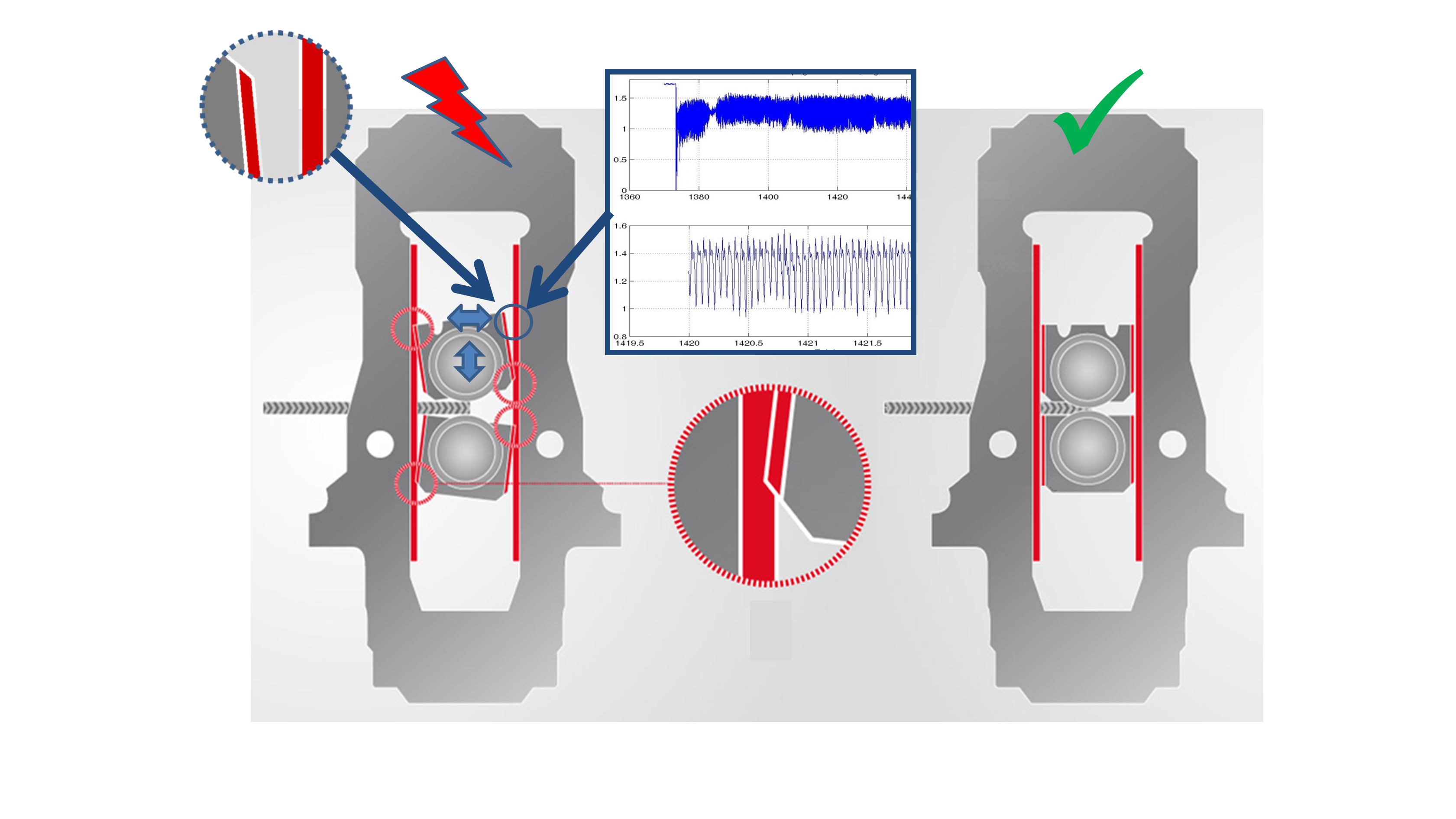
With more and more need for high-strength-steel the rolling-mills have to be expanded to deal with the resulting higher rolling-forces. An effect of this is the greater constriction of the rolling-stand. Therefore the flat-bearings, guiding the chocks, have to be designed thinner to avoid clamping. On the other hand, while rolling lower-strength-steel, these thinner flat-bearings cause worse guidance of the rolls, higher wear and greater oscillation tendency that allows self-excited vibrations to build up a high magnitude. This effect is known as chattering and can cause strip-breakage. A common reaction to this is to lower the speed of the rolling-mill which results in a reduced productivity of the plant.
In response to this trend a new adaptive flat-bearing was developed. The expected benefits of the new adaptive flat-bearing are on-line adaptation of a minimal bearing-gap, on-line adjustment of the roll-offset, dumping of self-excited vibrations and a possible use as an additional flatness-actuator.
Aims of the project:
- Better process-guiding for all Strengths.
- Minor oscillation tendency.
- Dumping of chattering vibrations without the need of speed reduction.
- Minor wear due to more parallel planes inside the bearing-gap.
This project is funded by the European Union. Views and opinions expressed are however those of the author(s) only and do not necessarily reflect those of the European Union. Neither the European Union nor the granting authority can be held responsible for them.


Steps to carry out the project:
- Initial setup.
- Development of needed controls.
- Test of expected benefits.
Benefits for the industrial partner:
- Higher productivity due to the avoiding of speed-reduction.
- Lower maintenance costs.
partners



Funding reference
Your contact person

Moritz Loos, M.Sc.
+49 211 98492-242
moritz.loos_at_bfi.de