

superProDR - Direct reduction process operation with superior productivity
Initial situation:
- The European steel industry faces the massive challenge of reducing its CO2 emissions by 55% by 2030 and becoming climate-neutral by 2050.
- The transformation roadmaps envisage replacing the previous production chain via the blast furnace with direct reduction (DR).
- Due to high natural gas and electricity prices in most European countries, however, it is difficult to operate the DR process competitively.
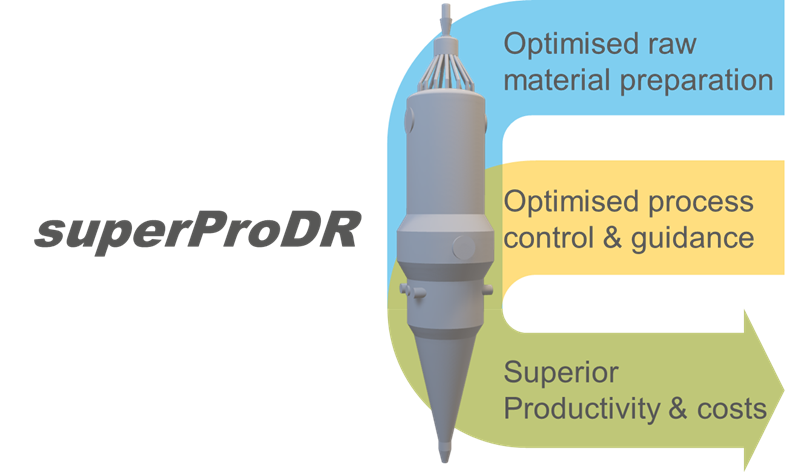
- To withstand global competitive pressure, European steelmakers must operate their DR plants at an outstanding level of productivity.
- This requires maximum throughput as well as high temperatures, which drastically increases the risk of the pellets sticking in the furnace.
- At the same time, cost minimization forces the use of lower quality and cheaper raw materials, which additionally affects permeability in the process.
Project targets:
- Enabling the European steel industry to operate DR processes at a superior level of efficiency and productivity while avoiding sticking.
- Development of new, high-temperature-resistant pellet coatings to reduce the sticking risk.
- Development of more realistic and standardized test methods to evaluate the sticking tendency of different raw materials and coatings.
- Creation of validated simulation models that calculate the spatial sticking risk, particle movement, and gas permeability in the process in detail.
- Development of new measurement concepts and digital tools for the early online detection of sticking and for optimal process control.
Innovative approaches:
- Research on innovative SiO2-based and hybrid organic-inorganic silicon coatings for iron ore pellets.
- First use of a high-temperature-resistant, gas-shielded shear cell reactor (Hot Shear Testing Reactor) for the realistic measurement of shear forces and sticking under DR conditions (up to 1000 °C).
- Coupled DEM-CFD simulations (Discrete Element Method and Computational Fluid Dynamics) for the precise analysis of the interaction between local gas flow, particle movement, and agglomerate formation.
- Transfer of the complex CFD-DEM findings into a fast FEM model (Finite Element Method), which acts as a "soft sensor" for online simulation of the DR shaft furnace.
- Simultaneous thermochemical calculation of the interactions between iron ore, pellet binders, and coatings using FactSage®.
Benefits for the industry:
- Productivity increase of the DR plants by an estimated 5% by safely enabling higher operating temperatures.
- Significant reduction of operating costs (estimated 10 € per tonne of crude steel) through the flexible and efficient use of cheaper raw materials such as blast furnace pellets.
- Avoidance of plant downtimes and process disruptions through the use of forecasting tools and precise early warning systems for sticking.
- Support for strategic raw material procurement through new standards that accurately assess the sticking risk on a plant-specific basis.
- Significant contribution to CO2 reduction (estimated 1 million tonnes of CO2 per year by 2035), which generates additional savings in emission allowances.
- Promotion of digital, data-driven steel production, which strengthens competitiveness and job security in the EU.
Further information:
Project website: https://superprodr.eu/
LinkedIn: SuperProDR project
This project is funded by the European Union. Views and opinions expressed are however those of the author(s) only and do not necessarily reflect those of the European Union. Neither the European Union nor the granting authority can be held responsible for them.

Funded by the European Union under Grant Agreement Number 101216556. Views and opinions expressed are however those of the author(s) only and do not necessarily reflect those of the European Union. Neither the European Union nor the granting authority can be held responsible for them.

partners

Funding reference
Your contact person

Thomas Piontek
+49 211 98492-258
Thomas.Piontek_at_bfi.de